A Guide for Design-Led Lean Product Management
Our Philosophy: Building with Intention
At CXT Software, we are transforming our product development approach, moving away from a reactive, output-focused model to a proactive, Design-Led Lean Product Organization. This means we build intentionally: starting with deep understanding and empathy, validating through research and design, and focusing relentlessly on outcomes, not just shipping features. Our goal is to deliver evidence-based, market-validated product solutions that increase customer value and recurring revenue while eliminating downstream delivery ambiguity.
This approach is a hybrid of Design Thinking and the Lean Product Playbook, and intended to be operated by Empowered Product Teams. TLDR: We slow down at the start to move exponentially faster later.
The Guiding Principles
-
Start with Discovery. Period. No tickets enter development without a validated problem statement.
-
Empathize and Understand: We establish strong, continuous, feedback channels to talk to our users, understand their needs, workflows, and jobs-to-be-done.
-
Validate Relentlessly: Ideas are hypotheses to be tested, not foregone conclusions; kill the weak ones early.
-
Iterate and Learn: Ship small, inspect outcomes, improve. We embrace feedback and refine solutions to be frictionless and intuitive.
-
Focus on Outcomes: Success is measured by real business and product outcomes (e.g., reducing CAC, improving LTV, increasing adoption, lowering time-to-value). Shipping features is not the same as delivering value.
-
Data-Driven Decisions: We leverage qualitative and quantitative data to inform our choices, from prioritization to measuring success.
-
Transparency and Alignment: Everyone has visibility into our process, priorities, and the "why" behind our decisions.
The Product Development Lifecycle
From Ideas to Outcomes
Our product lifecycle is designed to ensure we are solving the right problems and building the right solutions by following the Double Diamond design and innovation process.
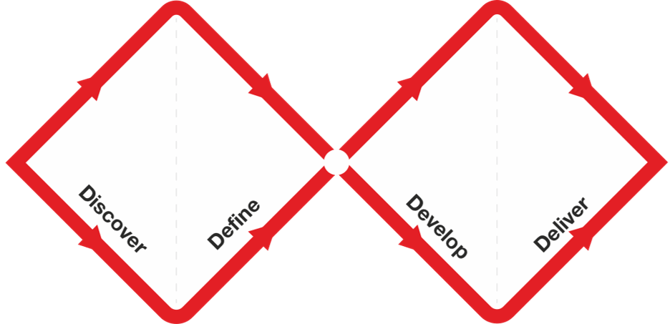
The Product Development Lifecycle (PDLC v2, updated Feb. 2026)
We keep the Double Diamond mindset (problem → solution), but we operate with a simplified, Epic-centered execution model.
Our delivery unit is the Jira Epic, synced to Productboard.
|
Stage |
Goal |
Required Outputs |
Productboard Status |
|
Capture & Triage |
Funnel all signals into one place and do a quick sanity check |
Insight logged + tagged, linked to area/objective, initial scoring placeholders |
Insight / New Idea |
|
Discovery |
Prove the problem is real and worth solving |
Discovery Brief: problem, evidence, scoring justification, hypothesis, risks, early solution direction |
Candidate |
|
Specification |
Create a build-ready blueprint with minimal ambiguity |
PRD w/ functional prototype (Figma Make / Google AI Studio), technicall spec, rollout plan, pricing notes, analytics plan |
Design / Planned |
|
Delivery |
Ship, enable, and verify outcomes |
Jira Epic + Stories flowing in Kanban, release notes, telemetry verified, Outcome Review at agreed checkpoints |
In Progress → Released/Launched |
Artifact policy (intentional simplification):
We minimize “artifact sprawl.” Every feature requires
-
Discovery Brief
-
PRD
-
Jira Work Items (Epics, Stories, Tasks, Releases)
-
Outcome Review
Other docs are optional and should be embedded as sections/links inside these core artifacts.
Toolchain & Sources of Truth
|
Need |
System |
Notes |
|
Planning & Prioritization |
Productboard |
Single source for ideas, scoring (WSJF‑RICE), roadmap |
|
Execution |
Jira |
Jira Epics are the unit of delivery. Epics are synced from Productboard and contain links to the Discovery Brief, PRD, prototype, and outcome review. Stories flow via Kanban |
|
Documentation |
Confluence |
Final PRDs, decision archive, release notes |
|
Design |
Figma / Google AI Studio |
Figma is the source of truth for UX and prototypes. For non-trivial initiatives, a functional prototype (Figma Make, Replit, etc.) is expected and linked from the PRD/Epic. |
|
Analytics |
Pendo |
Pendo is the source of truth for product usage and KPI measurement. Instrumentation requirements are defined in the PRD before build, and results are summarized in the Outcome Review. |
Prioritization Framework and Scoring
We score every validated opportunity with the Prioritization and Scoring Framework during the Discovery Brief process. No score → no slot on the roadmap.
Prioritization Framework and Scoring
Cultural Commitments
-
Continuous Discovery is a habit, not a phase. PMs carry the torch.
-
Empowered Product Teams own outcomes end‑to‑end. No hand‑offs, no blame.
-
Radical Transparency. Scores, backlogs, and results are visible company‑wide.
Own the Outcome. We celebrate impact, not releases.